Shipped
Redesigning safety experience
of women drivers for Grab
Overview
Grab is Southeast Asia’s leading all-in-one super app, connecting millions of users with rides, food delivery, groceries, parcel delivery, and more.
To improve the safety experience for women drivers, I worked across multiple product touchpoints to help them feel safer and more confident driving with Grab.
My role
Product Strategy
Research
End-to-end visual and interaction
Design
Timeline
Revamped SOS
Q1 - Q2, 2025
Safety Onboarding
Q2 - Q3, 2025
Driver First Responder
Ongoing, 2026
Women Preferred Toggle
Q1 - Q3, 2024
Platform
iOS
Android
Want detailed stories?
Much of My work is NDA. I can share highlights here, but more detailed case studies are available by contacting me.
Grab driver app
Grab Driver app helps millions of driver-partners across Southeast Asia earn and manage their work.
Background
Safety remains the biggest barrier preventing women from signing up as Grab drivers.
It's not simply about feeling safe. Safety influences whether women: sign up, choose when to drive, continue driving
* Note: Respondents allowed to select up to three barriers
Findings
Data also suggest that our women drivers

Discovery
Grab's one-size-fits-all safety experience wasn't enough to make our women drivers actually feel safe.
The same safety experience didn't feel the same. Grab's one-size-fits-all safety experience was not enough to make our women drivers actually feel safe.



Deeper insights
Working back from "safe"
Before jumping into design, I needed to define what success would look like. For years, Grab measured safety with a single metric: the P1C incident rate. It's the percentage of rides with a critical safety event. But a low incident rate didn't tell us whether women drivers actually felt safe.
So I unpacked the concept of "feeling safe" into three measurable dimensions, the 3A framework by partnering with our data scientists to investigate safety across Southeast Asia.
Metrics
Goal
Explanation
Assistance (P0)
Get help when they need it
Successful Assistance (but not redirected by Grab or did not respond to Grab yet)*
Adoption (P0)
Engage with safety features before problems occur
% of users who have adopted into x features, where X is defined based on the number of features we consider as optimum
Awareness (P1)
Know safety tools exist and how to access them
% of users who interact/click on safety related screens
Where "safe" breaks down
I also talked with women drivers and followed their journey. Their stories pointed to the same four moments where confidence breaks down.

Reframing
What women drivers want is
confidence in every moment.
That changed how I framed the problem. The opportunity wasn't simply to prevent more incidents. It was to reduce uncertainty before a ride, give drivers more control during it, and make help easier to reach when something goes wrong.

Redesign
Introducing
"Driving with Confidence"
Rather than building a single safety feature, I designed confidence across the entire driving journey from onboarding, to every ride, to what happens after an incident.
Shipped
Before the first trip
Safety onboarding
Instead of expecting drivers to discover safety tools when they needed them, we introduced them upfront to build confidence before the first ride.


Shipped
Before pickup
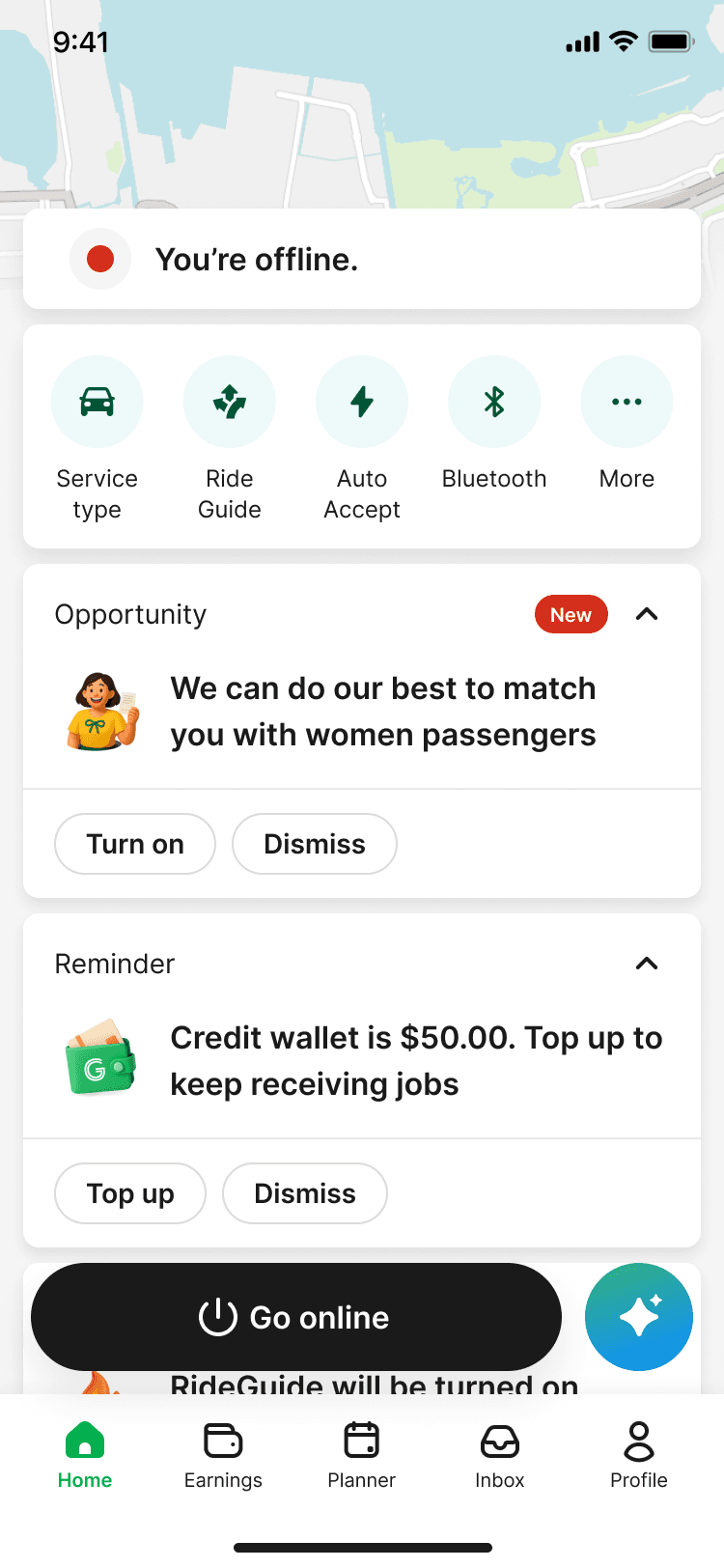
Women Passengers Preferred
One of the biggest sources of uncertainty was the person getting into the car. Women Passengers Preferred gives women drivers the option to get more jobs from women passengers.


Shipped
In transit
Faster SOS
The steps are reduced to reach SOS so women drivers can get to help faster, when they may already be under stress.



Standalone SOS
for women drivers
A standalone SOS button gives women drivers a direct call to a Grab Safety Agent.
Safety Preview
See what will be shared with the Safety Team and what happens after you trigger SOS.
One-Tap Support
One tap connects drivers to the Grab Safety Team, followed by a confirmation after the call.
Ongoing
In an emergency